The Annapurna Yojana 2026 has emerged as one of the most significant welfare initiatives aimed at providing financial assistance to eligible women in West Bengal. Under this scheme, qualified beneficiaries receive ₹3,000 per month directly into their bank accounts through the Direct Benefit Transfer (DBT) system. The initiative has been introduced to strengthen financial security, improve women’s economic independence, and support families facing financial challenges.
As awareness about the scheme continues to grow, thousands of applicants are searching for accurate information regarding the online application process, eligibility criteria, required documents, and beneficiary status tracking. Understanding the registration process is essential to ensure a smooth application experience and avoid mistakes that may lead to rejection.
This detailed guide explains the complete Annapurna Yojana 2026 Apply Online Steps, along with eligibility conditions, required documents, application status tracking, common mistakes to avoid, and frequently asked questions.
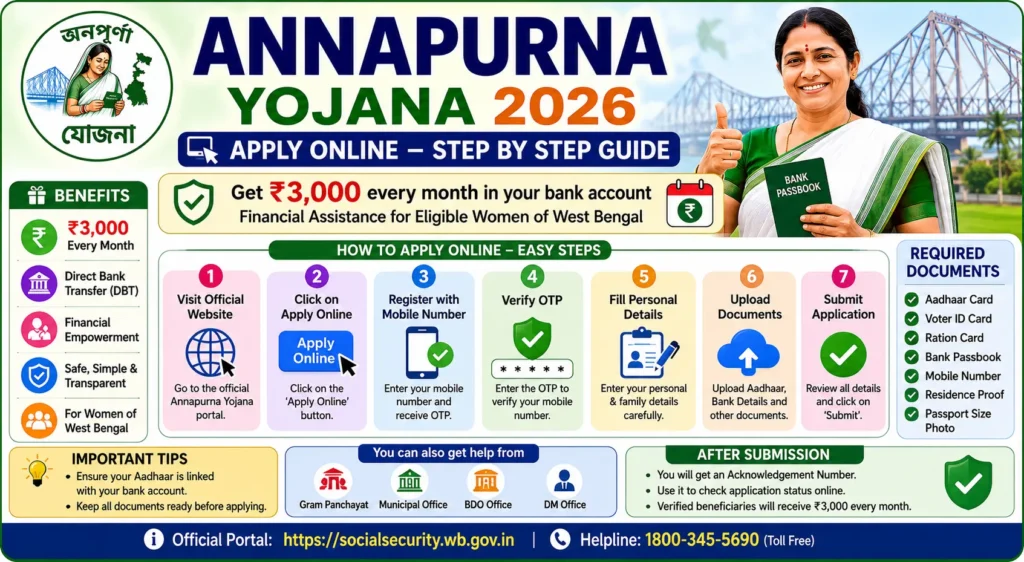
Annapurna Yojana Objectives
Annapurna Yojana 2026 is a financial assistance scheme launched for eligible women beneficiaries in West Bengal. The scheme provides monthly financial support of ₹3,000 to approved beneficiaries through the Direct Benefit Transfer mechanism.
The primary objective of the scheme is to provide financial stability to women and help families manage daily household expenses. By ensuring direct transfer of benefits into bank accounts, the government aims to eliminate intermediaries and maintain transparency in the distribution process.
The scheme is expected to benefit a large number of women, particularly those belonging to economically weaker sections of society.
Documents Required for Annapurna Yojana Application
Applicants should keep the following documents ready before beginning the registration process.
Identity Documents
- Aadhaar Card
- Voter ID Card
Address Proof
- Residence Certificate
- Ration Card
Banking Documents
- Bank Passbook
- Aadhaar Linked Account Details
Other Documents
- Mobile Number
- Passport Size Photograph
- Land Records (if available)
- Swasthya Sathi Card (if available)
- Caste Certificate (if applicable)
Having all documents prepared beforehand helps avoid delays during registration.
Annapurna Yojana Apply Online Steps
The online registration process is straightforward and can be completed using a smartphone, tablet, laptop, or desktop computer.
Step 1: Visit the Official Portal
The first step is to visit the official Annapurna Yojana or Social Registry portal.
Applicants should always use the official website and avoid relying on unofficial websites or agents.
Before proceeding, ensure that you have a stable internet connection.
Step 2: Click on Registration
On the homepage, locate the registration or apply online section.
New applicants should select the registration option.
Applicants who have already registered may use their login credentials.
Step 3: Mobile Number Verification
Enter your active mobile number.
The system will send a One-Time Password (OTP) to the registered number.
Enter the OTP correctly to verify your mobile number.
This step helps establish the authenticity of the applicant.
Step 4: Create Applicant Profile
After OTP verification, create your applicant profile.
Provide details such as:
- Full Name
- Date of Birth
- Gender
- Address
- District
- Block
- Postal Code
Ensure that all details match your official documents.
Step 5: Enter Aadhaar Details
The next step involves providing Aadhaar information.
Applicants should carefully enter:
- Aadhaar Number
- Name as per Aadhaar
Any mismatch between Aadhaar details and application information may result in verification issues.
Step 6: Add Bank Account Information
Applicants must provide accurate bank account details.
Required information generally includes:
- Bank Name
- Account Number
- IFSC Code
- Branch Name
Since benefits are transferred directly to the bank account, accuracy is extremely important.
Step 7: Enter Family Information
Applicants may be required to provide family-related details.
Information may include:
- Number of Family Members
- Family Identification Details
- Household Information
The government may use this information during eligibility verification.
Step 8: Upload Required Documents
Applicants should upload scanned copies of the required documents.
Ensure that:
- Documents are clear
- Images are readable
- File size is within limits
- Correct documents are uploaded
Poor-quality uploads may delay verification.
Step 9: Review the Application
Before final submission, carefully review all information entered.
Double-check:
- Aadhaar Number
- Name
- Bank Account Details
- Mobile Number
- Address Information
Many applications face delays because applicants fail to verify their information properly.
Step 10: Submit Application
After reviewing all details, submit the application.
Once submitted, the application enters the verification stage.
Applicants should avoid making multiple submissions.
Step 11: Download Acknowledgement Receipt
After successful submission, an acknowledgement receipt is generated.
Save or print the acknowledgement receipt for future reference.
The acknowledgement number is important for:
- Application Tracking
- Status Check
- Verification Follow-up
What Happens After Application Submission?
Many applicants wonder what happens after submitting their applications.
The application undergoes a verification process that may include:
- Identity Verification
- Aadhaar Authentication
- Address Verification
- Family Information Verification
- Bank Account Validation
- Eligibility Assessment
Only verified applicants are approved for benefits.
How to Check Annapurna Yojana Application Status?
Applicants can track the progress of their applications online.
Steps to Check Status
Step 1
Visit the official portal.
Step 2
Click on the “Application Status” option.
Step 3
Enter the required details.
Step 4
Submit the information.
Step 5
View the status displayed on the screen.
Possible status messages include:
- Submitted
- Under Verification
- Approved
- Rejected
- Payment Released
Common Reasons for Application Rejection
Applicants should be aware of common mistakes that can lead to rejection.
Incorrect Aadhaar Details
Mismatched Aadhaar information is one of the most common reasons for rejection.
Wrong Bank Account Information
Incorrect account numbers or IFSC codes can cause payment failures.
Incomplete Documentation
Failure to upload required documents may result in rejection.
Duplicate Applications
Submitting multiple applications may create verification issues.
Invalid Mobile Number
Applicants should use an active mobile number.
Failure to Meet Eligibility Conditions
Applicants who do not satisfy eligibility requirements may not receive benefits.
Important Tips for Successful Registration
To increase the chances of approval, applicants should follow these tips:
Keep Documents Ready
Gather all documents before starting the application process.
Verify Aadhaar Linking
Ensure that your Aadhaar is linked with your bank account.
Use Accurate Information
Provide information exactly as it appears on official documents.
Save Application Number
Keep the acknowledgement receipt and application number safe.
Monitor Status Regularly
Check the application status periodically.
Avoid Fraudulent Websites
Always use the official portal.
Importance of Aadhaar-Bank Linking
Aadhaar-bank linking plays a crucial role in the Direct Benefit Transfer system.
Benefits include:
- Faster Payments
- Improved Verification
- Reduced Fraud
- Direct Credit of Benefits
Applicants should complete Aadhaar seeding before applying.
Offline Assistance for Applicants
Applicants who face difficulties with online registration can seek assistance from:
- Gram Panchayat Office
- Municipal Office
- BDO Office
- DM Office
- Government Help Centres
These offices may assist with registration and verification-related queries.
Frequently Asked Questions (FAQs)
What is the monthly benefit amount?
Eligible beneficiaries receive ₹3,000 per month.
Can I apply online?
Yes, the scheme supports online registration.
Is Aadhaar mandatory?
Yes, Aadhaar is generally required for verification and DBT payments.
Can I check my application status online?
Yes, status checking facilities are available online.
What documents are required?
Aadhaar Card, Voter ID Card, Ration Card, Bank Passbook, Residence Proof, Mobile Number, Caste Certificate (if applicable), and supporting documents.
How will I receive the money?
The amount is transferred directly to the beneficiary’s bank account through DBT.
Can I apply offline?
Yes, assistance may be available through government offices.
Why is my application under verification?
The government verifies all submitted information before approval.
Conclusion
The Annapurna Yojana 2026 is an important welfare initiative that provides ₹3,000 per month to eligible women beneficiaries through the Direct Benefit Transfer system. The online registration process has been designed to be simple and transparent, allowing applicants to complete the application from the comfort of their homes.
By carefully following the application steps, preparing the required documents, ensuring Aadhaar-bank linking, and regularly tracking application status, eligible women can successfully access the financial assistance provided under the scheme.
If you are planning to apply, gather all necessary documents, verify your information, and complete the registration process carefully to avoid delays and ensure successful approval under the Annapurna Yojana 2026.